

Content Types


Last updated Oct 20th, 2026 | Page history | Improve this page | Report an issue
Support the team building MODX with a monthly donation.
The budget raised through OpenCollective is transparent, including payouts, and any contributor can apply to be paid for their work on MODX.
Backers


Budget
$194 per month—let's make that $500!
Learn moreWhat are Content Types?
A Content Type maps Resources to a MIME type and one or more file extensions. MODX uses it to build the Resource URI and to send the Content-Type header.
With Friendly URLs, MODX appends the first file extension of the Content Type to the Resource alias. A Resource with the alias test and the CSS Content Type renders as:
test.css
instead of test.html. This lets you serve CSS, XML, JSON, and other files from Resources.
Usage
When editing a Resource, open the Settings tab and select the Content Type:
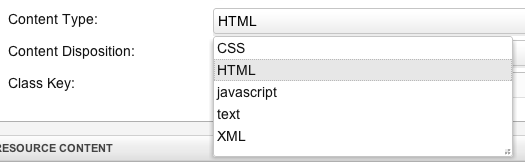
Save the Resource to apply the type.
Creating New Content Types
Go to Content > Content Types and click New Content Type:
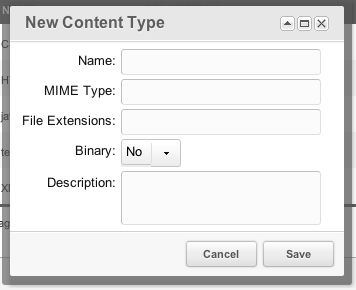
- Name — the label in the manager. It does not affect output.
- MIME Type — the
Content-Typesent to the browser, such astext/css. - File Extensions — the extensions for this type, including the dot (
.css). Separate several with commas:.html,.htm. MODX uses the first extension when it builds the URI. - Icon — an optional CSS class for the Resource tree icon (MODX 3.0+), such as
icon-css,icon-json,icon-pdf,icon-home, orfa-home. - Binary — whether the file is binary. Binary types are sent as-is; text types receive a charset.
- Description — an optional note for manager users.
- Custom headers — complete HTTP header lines, one per row. See below.
Click Save to add the type to the grid.
Custom headers
The Custom headers tab holds complete header lines, for example:
X-Frame-Options: DENY
MODX sends these headers with every Resource that uses the Content Type. For binary Static Resources, the headers are sent before the file is streamed.
Protected Content Types
MODX ships eight protected types:
- HTML
- XML
- Text
- CSS
- JavaScript
- RSS
- JSON
The manager does not offer Delete for a protected type. Its name, MIME type, and description are read-only, while the icon and file extensions can still change. Creating, editing, or deleting a Content Type requires the content_types permission.
Resource tree icons
MODX adds every applicable icon class to the Resource tree node. This includes the Content Type icon, the Template Manager Icon Class, and the type and default classes. All classes are returned, so the theme CSS decides which one is visible.
When neither the Content Type nor the Template sets an icon, MODX uses mgr_tree_icon_{classKey} — for example tree-resource for a Document. Weblinks, Symlinks, and Static Resources have their own defaults.
Core Content Types ship with icons for non-HTML MIME types: icon-xml, icon-css, icon-js, icon-json, icon-pdf, and similar. HTML usually has an empty Icon, so the normal document or folder icon remains.
You can edit the Icon inline in the Content Types grid or in the create/update window. See Templates for the Template Manager Icon Class field.
See Also
Support the team building MODX with a monthly donation.
The budget raised through OpenCollective is transparent, including payouts, and any contributor can apply to be paid for their work on MODX.
Backers
Budget
$194 per month—let's make that $500!
Learn more